
Your Skin Feels Stress Too. Here's What That Means — and What You Can Do About It
This week, millions of people across the UK will pause to think about mental health — what it means, what gets in the way of it, and what small actions can actually make a difference. Mental Health Awareness Week runs from 11 to 17 May, and this year's theme from the Mental Health Foundation is Action. Not just awareness. Action.
We want to talk about one connection that rarely makes it into the mental health conversation — and yet affects almost every family we know: the relationship between stress and your skin.
Your skin and your mind are in constant conversation
The skin is the body's largest organ. It is also, in ways that science is still uncovering, deeply connected to the nervous system. Researchers refer to this as the brain-skin axis — a two-way communication channel through which psychological stress produces measurable, visible effects on the skin, and skin conditions in turn feed back into emotional and mental wellbeing.
When you experience stress, your body activates its natural stress response, releasing hormones including cortisol. In the short term, this is protective — a survival mechanism. But when stress is sustained, elevated cortisol levels begin to work against the skin in several important ways: they weaken the skin's protective barrier, increase inflammation throughout the body, and make it harder for the skin to retain moisture and repair itself.
Research published in the British Journal of Dermatology (Evers et al., 2010) found that periods of heightened daily stress reliably preceded worsening of chronic skin conditions such as psoriasis. A more recent paper published in Science (Basso, 2026) identified a specific neuroimmune pathway through which psychological stress directly aggravates inflammatory skin conditions — a significant finding that deepens our understanding of just how real this connection is.
For families managing eczema, sensitivity, or persistent dryness, this is not abstract science. It is lived experience. The flare that arrives during exam season. The skin that tightens and itches during a difficult period at work. The child whose patches worsen during unsettled weeks. Stress does not cause these conditions, but it is a well-established trigger — one that deserves to be taken seriously alongside the ingredient labels and the products.
The cycle that keeps going
What makes this particularly hard is that the relationship runs in both directions. Skin conditions cause stress. And stress worsens skin conditions.
Research shows that over 30% of people with atopic skin disease experience anxiety or depression alongside their condition. The itch that disturbs sleep. The self-consciousness of visible flares. The exhaustion of managing something that feels unpredictable. These experiences have a real and measurable impact on mental health — which then feeds back into the skin. Understanding this cycle is the first step to finding ways to interrupt it.
What action actually looks like
In the spirit of this year's theme — Action — here are some genuinely useful things that can make a difference. Not an overwhelming list. A few things worth doing.
Protect the skin barrier consistently, not just reactively. A strengthened skin barrier is less vulnerable to stress-induced inflammation. Daily, consistent moisturising — applied to damp skin after bathing, as we explored in our last post — is one of the most evidence-based things a family can do for stress-related skin sensitivity. It does not have to be complicated.
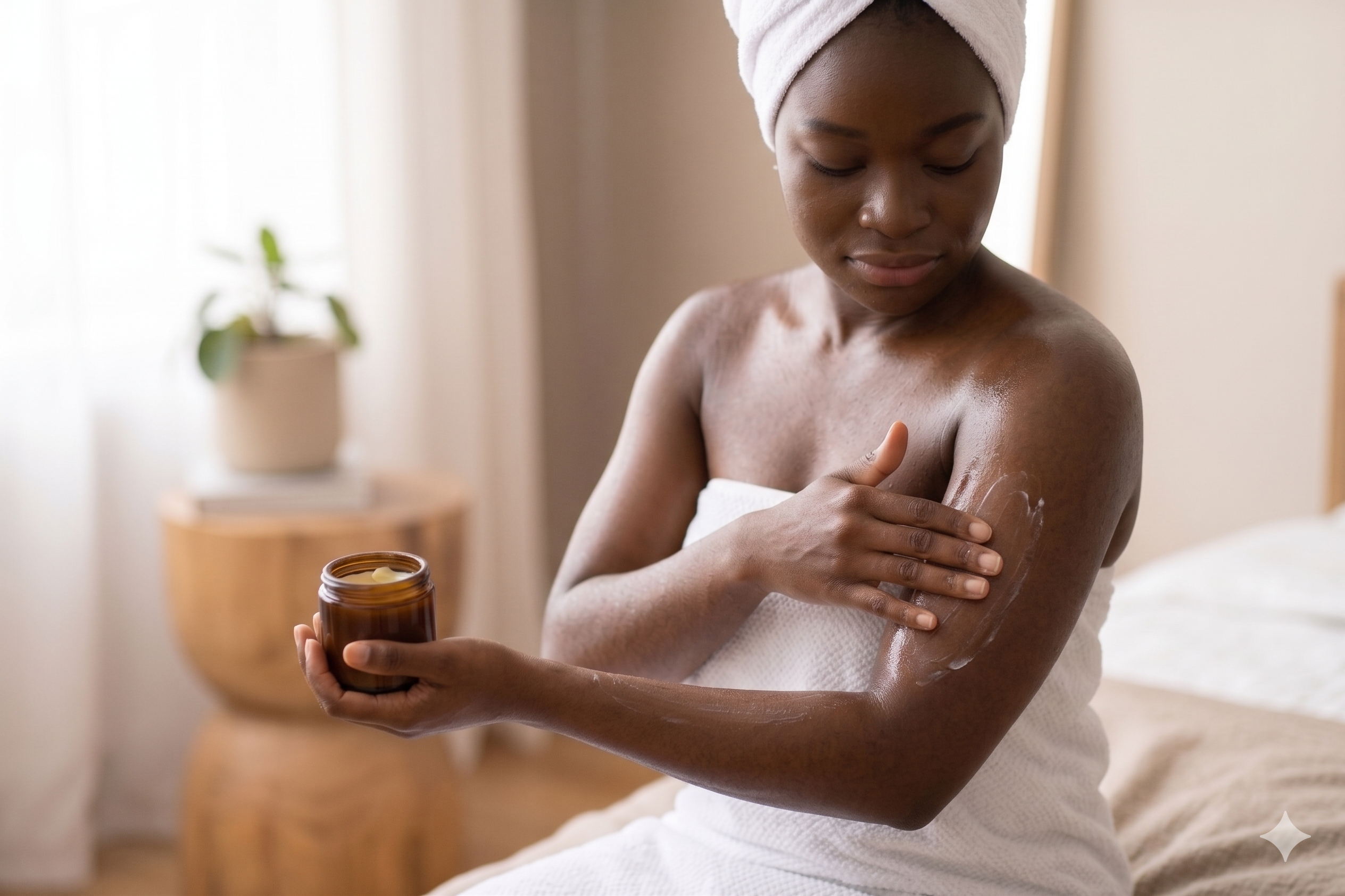
Use skincare as a moment of intentional care. This is not about turning every product application into a wellness programme. It is something simpler: that the act of taking a few deliberate, unhurried minutes to care for your skin — or your child's skin — has a calming effect on the nervous system that is backed by real science. Touch promotes the release of oxytocin. Scent engages the limbic system. Slowing down activates the parasympathetic nervous system — the body's rest-and-recover mode. A small, purposeful moment of care is not nothing. It is something.
Pay attention to the pattern, not just the flare. Keeping a loose mental note of when skin worsens — what else was happening that week, what changed — can help identify personal stress triggers. This awareness, over time, gives families more agency over a condition that can otherwise feel entirely random.
Reach out when the cycle feels unmanageable. Skincare can support skin. It cannot replace the support that persistent mental health challenges deserve. If stress-related skin problems are significantly affecting quality of life, speaking to a GP or dermatologist is the right next step. There is no version of self-care that replaces professional care when it is needed.
What we put in every jar
Elysian Luxe Nourishing Body Butter was formulated with this kind of care in mind — not as a response to a trend, but from over a decade of lived experience caring for skin that needed something genuinely clean, genuinely nourishing, and genuinely trustworthy. The lavender and geranium oils in the formulation are not there for fragrance alone. Both have well-documented calming properties. The shea, avocado, coconut, jojoba, and mango butter work together to strengthen and support the skin barrier — reducing its vulnerability to the kind of stress-driven inflammation this post describes.
We cannot promise it will fix everything. We can promise it was made with intention and integrity, for real families, with real needs.
This Mental Health Awareness Week — take one small action for your skin. And for yourself.
Pure. Proven. Personal.
Explore Elysian Luxe Nourishing Body Butter
We believe in the power of nature, but we are not medical professionals. Always consult with a GP or dermatologist for persistent skin concerns.
References:
- Evers, A.W.M., Verhoeven, E.W.M., Kraaimaat, F.W., et al. (2010). How stress gets under the skin: cortisol and stress reactivity in psoriasis. British Journal of Dermatology, 163(5), 986–991. https://doi.org/10.1111/j.1365-2133.2010.09984.x
- Basso, L. (2026). A neuroimmune circuit links stress to skin inflammation. Science, 391, 1208–1209. https://doi.org/10.1126/science.aef7718
- Mental Health Foundation. (2026). Mental Health Awareness Week 2026: Action. https://www.mentalhealth.org.uk/our-work/public-engagement/mental-health-awareness-week